ALMM and DCR modules are two different rules that installers keep mixing up: ALMM is MNRE's approved list of module and cell models you are allowed to use, while DCR is a subsidy condition that the cells and modules be made in India. You can lose a subsidy claim by getting either one wrong, so here is what each list covers, which project needs which module, and what changes on 31 December 2026.
Everything below on ALMM and DCR modules is checked against MNRE orders, the official ALMM list pages and the NISE DCR portal as of September 2026. ALMM has moved fast this year, with clarifications issued in June, July and August 2026, so confirm the current position on mnre.gov.in before you commit a price to a customer.
ALMM and DCR modules: the 30-second answer
- ALMM List-I = approved module models and manufacturers. If your panel model is not on it, it cannot be used in the projects ALMM covers.
- ALMM List-II = approved solar cell models and manufacturers. It controls where the cell inside the module was made.
- DCR = Domestic Content Requirement. A subsidy condition: the cells and the module must both be domestically manufactured, and traceable on the NISE DCR portal.
The single sentence to remember: ALMM decides what you may install, DCR decides what you get paid a subsidy for. A module can sit on ALMM List-I and still be a non-DCR panel, because it was assembled in India with imported cells.
What ALMM List-I and List-II actually are
ALMM stands for Approved List of Models and Manufacturers. It runs under MNRE's "Approved Models and Manufacturers of Solar Photovoltaic Modules (Requirement for Compulsory Registration) Order, 2019", issued in January 2019. MNRE owns the policy; the National Institute of Solar Energy (NISE) runs the enlistment process, factory inspections and the ALMM cell that processes applications.
List-I: solar PV modules
List-I has been running since March 2021. It names every module model and manufacturer eligible for government projects, government-assisted projects and schemes, and for projects selling power under the Electricity Act, 2003. "Government" here is read widely: central and state bodies, PSUs and autonomous bodies. MNRE refreshes it often — the version current at the time of writing is dated 16 September 2026.
List-II: solar PV cells
List-II was first issued on 31 July 2025 and took effect from 1 June 2026. It does the same job one step up the supply chain: it lists approved Indian cell manufacturers, so an ALMM-covered project must use a List-I module whose cells come from a List-II manufacturer. It is revised regularly too — the 9th revision is dated 21 August 2026.
List-III: wafers, later
MNRE amended the ALMM order on 17 March 2026 to add List-III for solar wafers, reported to take effect from 1 June 2028. Nothing for a rooftop installer to do today, but it tells you the direction: the whole chain is being localised step by step.
ALMM List-I vs List-II vs DCR compared
| ALMM List-I | ALMM List-II | DCR | |
|---|---|---|---|
| What it covers | Finished solar PV module models | Solar PV cell models | Indian-made cells and Indian-made modules |
| Type of rule | Eligibility list | Eligibility list | Subsidy / scheme condition |
| Who maintains it | MNRE, enlistment by NISE | MNRE, enlistment by NISE | MNRE scheme guidelines; traceability on the NISE Solar DCR Verification Portal |
| In force since | March 2021 | Issued 31 July 2025, effective 1 June 2026 | Long-standing condition in MNRE subsidy schemes |
| Where you check it | ALMM List-I PDF on mnre.gov.in | ALMM List-II PDF on mnre.gov.in | DCR certificate number on solardcrportal.nise.res.in |
| What goes wrong | Unlisted model — DISCOM or agency rejects the installation | Imported cell after the cut-off — project not allowed to commission | Missing certificate or mismatched serials — subsidy not disbursed |
Note the last row. These three failures happen at three different points: at approval, at commissioning and at subsidy release. An installer can clear the first two and still lose money on the third.
Which project needs which module
This is the table worth printing and sticking on your procurement desk. It reflects MNRE's clarification of 4 August 2026, which set out List-II applicability category by category, together with the earlier orders of 8 June, 6 July and 18 July 2026.
| Project type | ALMM List-I module? | ALMM List-II cell? | DCR module? |
|---|---|---|---|
| PM Surya Ghar residential, claiming central subsidy | Yes | Yes — domestic cells required by DCR in any case | Yes |
| PM Surya Ghar residential, "Give It Up" (subsidy forgone) with net metering | Yes | Exempt for systems commissioned up to 31 March 2027 | No |
| Other net-metered projects (no MNRE subsidy) | Yes | Exempt if commissioned on or before 31 Dec 2026; required after | No |
| Open access / group captive RE projects | Yes | Same window: exempt up to 31 Dec 2026 | No |
| Government rooftop, not awarded by competitive bidding | Yes | Exempt if commissioned on or before 31 Dec 2026 | As per scheme guidelines |
| Government / government-assisted projects bid after 31 Aug 2025 | Yes | Yes | As per scheme guidelines |
| Behind-the-meter captive plant of a private consumer | Not applicable | Not applicable | No |
Two cautions. First, behind-the-meter exemption is for private consumers and groups of consumers — government entities and PSUs are excluded. Second, MNRE has been explicit that these ALMM clarifications do not relax DCR. If a scheme requires domestic content, an ALMM exemption does not get you out of it.
The 2026 timeline you need to plan around
The dates matter because they are commissioning dates, not order dates or sanction dates. A project that slips past a deadline changes its bill of materials.
- 1 June 2026 — ALMM List-II takes effect for solar PV cells.
- 25 May 2026 — MNRE confirms there will be no blanket extension of List-II beyond 1 June 2026, subject to protecting investments already made.
- 8 June 2026 — exemption from List-II clarified for rooftop solar under the PM Surya Ghar "Give It Up" category, up to 31 March 2027. Such beneficiaries do not have to apply separately on the NISE DCR portal for the exemption.
- 6 July 2026 — clarification on List-II for rooftop solar on government buildings.
- 11 July 2026 — MNRE notice on the re-opening of the NISE DCR portal.
- 18 July 2026 — the key one for rooftop: net-metering and open-access projects may be commissioned without meeting List-II only up to 31 December 2026. MNRE stressed this is a limited window, not a policy change.
- 4 August 2026 — consolidated clarification of List-II applicability across project categories.
- 1 January 2027 — net-metering and open-access projects commissioned from this date must use ALMM List-II cells.
Practically, if you are quoting a net-metered job in late 2026, check the DISCOM's realistic commissioning timeline before you price non-DCR modules into it. Our net metering process guide sets out the steps and where they usually stall.
How to check whether a module is ALMM approved
There is no shortcut and no third-party database worth trusting. Go to the source.
- Open the ALMM page on mnre.gov.in and download the latest List-I under ALMM order for Solar PV Modules. Check the date on the file — it is republished every few weeks.
- Search the PDF for the manufacturer's name, then for the exact model number on the supplier's datasheet, including any suffix. A model family being listed does not mean your specific variant is.
- Check that the wattage of the model you are buying falls inside the listed range or power bin for that model.
- For the cell, download the latest ALMM List-II for Solar PV Cells revision and confirm the cell manufacturer your module maker has named.
- Keep a dated screenshot or the PDF itself in the project file. If a model is delisted later, you want evidence of what the list said when you bought.
MNRE also publishes FAQs on the List-II memorandum. If a supplier cannot give you their List-I model entry and List-II cell source in one WhatsApp reply, treat that as a warning sign.
DCR certificates, serial numbers and rejected subsidies
This is where most PM Surya Ghar claims actually fail, and it is entirely avoidable.
Domestic content is traced through the Solar DCR Verification Portal run by NISE. Manufacturers register cells and modules there with unique serial numbers, and resellers and EPCs pass the traceability down the chain. The vendor generates a DCR certificate for the consumer's specific modules, and that certificate number goes on the PM Surya Ghar National Portal. Trade reporting describes it as a 16-digit number; confirm the format on the portal itself when you generate one.
MNRE tightened this in 2026 after duplicate serial numbers appeared in the system:
- Module serial numbers are auto-fetched from the DCR certificate number rather than typed in by the vendor. Inverter serial numbers are still entered manually.
- Repeated module or inverter serial numbers are flagged automatically.
- For new applications submitted after 26 May 2026, a vendor undertaking is no longer accepted as a fix for repeated serial numbers. Earlier applications with repeats go back to the vendor for correction and re-verification.
The failure mode is simple. The serials on the panels physically installed on the roof must match the serials tied to the DCR certificate, which must match what the portal holds. If a storekeeper swaps two pallets between jobs, or a supplier issues a certificate against modules that went somewhere else, the claim stalls and the household's ₹78,000 does not arrive. You are the one who has to explain that.
DCR vs non-DCR price and what it does to your quote
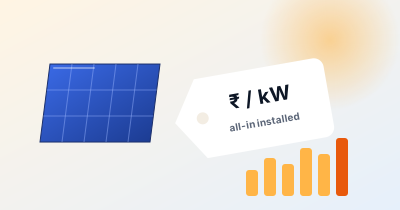
Indicative 2026 market prices put DCR modules at roughly ₹22–26 per watt against about ₹14–16 per watt for non-DCR. These are market ranges from published price guides, not official benchmarks, and they move with cell supply, order size and brand.
Example (illustrative, not a quote): on a 3 kW system, a gap of ₹9 per watt is 3,000 × ₹9 = ₹27,000 extra for DCR modules. Against a central subsidy of ₹78,000, the customer is still about ₹51,000 better off going the DCR route. That arithmetic is why DCR is the obvious choice for a subsidised residential job, and it holds across the ₹8–11 per watt gap commonly quoted.
Where it gets interesting is the non-subsidised net-metered job — a shop, a small factory, a large villa. There, non-DCR is genuinely cheaper today, and that advantage narrows once List-II applies from 1 January 2027. Our breakdown of rooftop solar cost per kW covers how module choice sits inside the total installed price.
A procurement checklist for installers
Getting ALMM and DCR modules right is mostly a paperwork discipline. Ask for all of this in writing, before payment, on every DCR job:
- ALMM List-I entry — manufacturer name and exact model number as it appears in the current list, plus the list date.
- Cell source — the cell manufacturer, and their ALMM List-II entry where the project needs it.
- DCR certificate — issued for the specific serial numbers you are receiving, generated on the NISE DCR portal, with the certificate number recorded in your project file.
- Serial number list — a soft copy from the supplier that you physically verify against the pallets on delivery, not after installation.
- Tax invoice — matching make, model, wattage, quantity and HSN, with GST shown correctly. See our solar quotation format guide for how this should flow through to the customer document.
- Warranty papers — product warranty and performance warranty separately stated, in the manufacturer's name, with the claim process and Indian service contact.
- Datasheet and test reports — BIS registration and the IEC test report references for the model.
- Photographs — serial labels, packing list and delivery challan, stored against the customer record.
Keeping module make, model, DCR status and serial numbers attached to each customer record from the quotation stage onward is the cheapest insurance there is. Proposal tools like PitchSun keep that detail with the proposal, so the specification the customer approved is the specification you procure against and upload later.
What to tell a customer
Homeowners hear "DCR" as jargon and assume it means a cheaper, poorer panel. Say it plainly: the subsidy is paid only on Indian-made panels, those cost a little more per watt, and the subsidy is several times the difference. Then show both numbers in the quote.
Frequently asked questions
What is a DCR solar panel?
A DCR (Domestic Content Requirement) solar panel is a module where both the module and the solar cells inside it are made in India. Non-DCR modules are assembled with imported cells, usually from China. DCR modules are required for projects that claim a central subsidy, including PM Surya Ghar residential systems.
What is the difference between ALMM List-I and List-II?
ALMM List-I is MNRE's approved list of solar PV module models and manufacturers. ALMM List-II is the approved list of solar PV cell models and manufacturers, first issued on 31 July 2025. List-I controls which finished panel you can use; List-II controls where the cell inside it came from.
Is ALMM the same as DCR?
No. ALMM is a quality and origin list that decides which module models may be used in government-linked, net-metered and open-access projects. DCR is a subsidy condition that requires Indian-made cells and modules. A module can be on ALMM List-I and still not be DCR.
Do I need DCR modules for PM Surya Ghar?
Yes, if the consumer is claiming the central subsidy. DCR modules must be used or the Central Financial Assistance is not disbursed. Consumers who opt for the Give It Up category and forgo the subsidy are exempt from the ALMM List-II cell requirement for systems commissioned up to 31 March 2027.
What happens to net-metered projects after 31 December 2026?
MNRE's office memorandum of 18 July 2026 allows net-metering and open-access renewable projects commissioned on or before 31 December 2026 to be built without meeting ALMM List-II. Projects commissioned from 1 January 2027 must use cells from ALMM List-II manufacturers. Confirm the position on mnre.gov.in before you quote.
How much more do DCR modules cost than non-DCR?
Indicative 2026 market prices put DCR modules at roughly ₹22–26 per watt against about ₹14–16 per watt for non-DCR. On a 3 kW system that is a gap of about ₹24,000–₹33,000, which is still well below the ₹78,000 PM Surya Ghar subsidy.
Sources
- MNRE — Approved List of Models and Manufacturers (ALMM): orders, List-I, List-II and clarifications
- MNRE — O.M. dated 18 July 2026: limited window till 31.12.2026 for net-metering and open access projects
- MNRE — ALMM List-II for solar PV cells: Clarification, 4 August 2026
- MNRE — No blanket extension of ALMM List-II beyond 01.06.2026, 25 May 2026
- PIB — No blanket extension of ALMM List-II beyond 1st June 2026 (25 May 2026)
- MNRE — Domestic Content Requirement (DCR) under solar PV projects in MNRE schemes: clarification
- NISE — Solar DCR Verification Portal
- NISE — ALMM enlistment, inspections and ALMM cell
- MNRE — PM Surya Ghar National Portal for Rooftop Solar
- Mercom India — MNRE mandates generating a DCR certificate number on the PM Surya Ghar portal
- Saur Energy — MNRE tightens PM Surya Ghar rules on repeated module and inverter serial numbers (26 May 2026)
- Saur Energy — Non-DCR modules allowed under the PM Surya Ghar "Give It Up" option (June 2026)
- SolarQuarter — MNRE expands the ALMM framework to solar wafers (List-III), March 2026
- Heaven Green Energy — DCR vs non-DCR module price gap (2026 market survey)