A solar loan is what turns a ₹2 lakh quotation into a monthly number a family can compare with their electricity bill. Under PM Surya Ghar, public-sector banks lend up to ₹2 lakh for residential rooftop systems without collateral, at the RBI repo rate plus 50 basis points — about 5.75% a year while the repo rate stands at 5.25% (September 2026).
This guide covers what the banks actually offer, what the EMI looks like against the bill saving, which documents to collect, and how installers should use finance in a sales conversation without over-promising.
What the PM Surya Ghar solar loan offers
| System up to 3 kW | System above 3 kW | |
|---|---|---|
| Loan amount | Up to ₹2 lakh | Up to ₹6 lakh |
| Interest | Repo + 50 bps (≈5.75% at a 5.25% repo) | Home-loan rate; about +100 bps for non-home-loan customers |
| Security | Collateral-free — the system is hypothecated | As per the bank's retail rules |
| Margin (your contribution) | Typically 10–20% of project cost | |
| Tenure | Up to 120 months, commonly with a 6-month moratorium | |
| Processing fee | Nil at several public-sector banks | |
These are the terms published by public-sector banks that have aligned their rooftop products with the scheme — Indian Bank's published product, for example, states ₹2 lakh at repo + 50 bps for up to 3 kW, ₹6 lakh above it, hypothecation of the system as security, 120 months including a six-month moratorium and nil processing charges. Rates and margins differ slightly between banks and change with the repo, so treat these as the shape of the offer and confirm the numbers at the branch.
What the EMI actually looks like
Example. A 3 kW residential system quoted at ₹1,80,000 including GST, in a state with no extra top-up subsidy:
- PM Surya Ghar subsidy: ₹78,000, credited after commissioning.
- Customer's own margin at 20%: ₹36,000.
- Loan taken: ₹1,44,000 over 10 years at 5.75%.
- EMI: approximately ₹1,580 a month.
A 3 kW system in most of India generates roughly 4,000–4,500 units a year, or about 350 units a month. At a residential slab rate of ₹8 a unit that is around ₹2,800 of electricity a month. The EMI sits well under the saving, which is the whole argument: the system pays its own instalment and leaves change.
Now use the subsidy. When the ₹78,000 lands, the borrower can part-prepay, which on a floating retail loan usually carries no penalty. The balance drops to about ₹66,000 and the loan closes years early, or the EMI falls to roughly ₹730 if the bank re-fixes the instalment instead of the tenure. Ask which of the two the bank does — they are very different conversations for the customer.
Run the arithmetic for your own bill on our free solar subsidy calculator, which applies the same slab rules as the scheme, and see rooftop solar cost per kW for what should be in the price you are financing.
Documents the bank will ask for
- Aadhaar and PAN of the applicant.
- The latest electricity bill — in the applicant's name, matching the connection the system will sit on.
- Income proof: salary slips and Form 16 for salaried applicants, ITR and business proof for the self-employed.
- Bank statements for six to twelve months.
- The installer's quotation with the bill of materials and the total cost.
- The PM Surya Ghar application number or the DISCOM's feasibility approval.
- Photographs of the roof in some cases, and property ownership proof where the bank asks for it.
The name mismatch is the single most common reason a file stalls: the bill is in a father's name, the loan is in the son's, and the subsidy account is a third name. Check the bill, the Aadhaar and the bank account at the site survey, before anything is filed.
What the bank actually checks
A rooftop solar file is a small retail loan, so it is assessed like one. Four things decide it:
- Repayment capacity. Salary or business income against existing EMIs. A ₹1,580 instalment is small, which is why these files are usually straightforward for anyone already servicing a loan comfortably.
- Credit history. The bureau score and any recent defaults. Nothing about solar changes the bank's normal cut-off.
- The connection and the applicant. The electricity bill should be in the borrower's name, or the owner should be a co-applicant. This is where files stall most often — a bill in a late parent's name needs the connection transferred first, and that is a DISCOM process of its own.
- The project. A quotation with a proper bill of materials, and the PM Surya Ghar application or feasibility approval, so the bank can see the system is approved and the subsidy is real.
Two situations need a different route. Tenants cannot mortgage or modify a roof they do not own, so the owner has to be part of the application. Housing societies installing a common-area system borrow as a society, against a resolution and the society's accounts, not under the residential scheme's ₹2 lakh line.
How the money moves
- The loan is sanctioned after feasibility approval on the portal.
- Banks commonly disburse in two parts — around 70% against the sanctioned proposal and the balance after installation is verified, often within 30 days of commissioning.
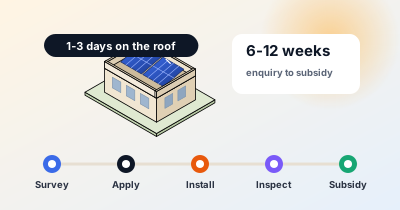
- The moratorium covers the installation and inspection weeks; the EMI starts after it.
- The subsidy is credited by the government directly to the consumer's account after the commissioning certificate is uploaded, and is typically used to part-prepay.
Government-backed retail loans can also be applied for through the Jan Samarth portal, which routes an application to participating banks. Many customers still find it faster to walk into the branch where they already have an account.
What installers should do with this
Finance is not a discount, but it changes the question the customer is answering. "₹1.8 lakh" invites a comparison with a holiday or a car down payment. "About ₹1,580 a month against a ₹2,800 bill" invites a comparison with the bill itself — and that is a comparison solar wins.
- Put the EMI on the proposal, next to the monthly saving, with the tenure and rate stated. If your proposal tool can do it — PitchSun does — show the EMI and the saving on the same line.
- Say the rate is floating and that it moves with the repo. Customers remember the person who told them before it changed.
- Show both scenarios: EMI with the subsidy used to prepay, and without.
- Know two branches in your area that have actually disbursed under the scheme. A manager who has done ten of these files is worth more than a list of twelve banks.
- Do not collect documents on the bank's behalf or make sanction promises. Help the customer prepare the file; let the bank sanction it.
Is a solar loan worth it?
For a household whose bill is above ₹2,000 a month and whose roof is unshaded, the EMI is normally smaller than the electricity it replaces from the first month, and the asset keeps producing long after the loan closes. The cases where it does not work are the ones an honest installer should walk away from: a heavily shaded roof, a bill too small to save against, a tenant without the owner's consent, or a connection whose sanctioned load cannot carry the system.
Before promising anything, read the subsidy rules and check the net metering process for the state — the loan is the easy part of the file; the DISCOM steps are where time goes.
Frequently asked questions
What is the interest rate on a solar loan under PM Surya Ghar?
For residential systems up to 3 kW, public-sector banks lend up to ₹2 lakh at the RBI repo rate plus 50 basis points. With the repo rate at 5.25% in September 2026 that works out to about 5.75% a year, but the rate moves with the repo, so confirm the current figure with the bank.
Is a solar loan collateral-free?
Up to ₹2 lakh, yes. No property or gold is pledged — the rooftop system itself is hypothecated to the bank. Above that amount banks usually treat it like a home-loan top-up, with their normal security and rate rules.
How much loan can I get for a system above 3 kW?
Public-sector banks typically lend up to ₹6 lakh for residential systems above 3 kW. Existing home-loan customers usually get it at their home-loan rate; other applicants pay roughly 100 basis points more.
What is the tenure and is there a moratorium?
Up to 120 months, which commonly includes a six-month moratorium while the system is installed and commissioned. Prepayment is generally allowed without a penalty on floating-rate retail loans.
What documents are needed for a solar loan?
Identity and address proof (Aadhaar and PAN), the latest electricity bill in the applicant's name, income proof such as salary slips or ITR, six to twelve months of bank statements, the installer's quotation and the PM Surya Ghar application or feasibility approval.
Does the subsidy reduce the loan amount?
Yes, in effect. The bank finances the project cost and the PM Surya Ghar subsidy is later credited to the borrower's account, which most people use to part-prepay the loan. Ask the bank to tell you the EMI both with and without that prepayment before you sign.